


For this review, I evaluated ProxyStores for marketplace research specifically for public marketplace seller research and regional assortment checks. I focused on the parts I could verify responsibly: the public order flow, available proxy types, location controls, protocol support, pricing structure, and how a repeatable test plan can be built around a fixed regional endpoint. I did not invent private success rates, long-term uptime figures, or claim that I had run high-volume automation against third-party sites. The goal was to see whether the service structure makes sense for lawful quality assurance and research where page content can change by visitor location.
My test plan centered on whether public seller pages, category placement, delivery notices, currency, and regional availability differ between markets. I created a simple matrix with target market, proxy type, browser language, clean-cookie state, observed page, and result. That kept the network condition separate from other variables such as account state, personalization, and browser locale. The most useful lesson was that a proxy is not evidence by itself; it is a controlled viewpoint. When the same regional behavior can be reproduced with the same endpoint and the same browser conditions, it becomes much easier to document a genuine website difference instead of guessing.
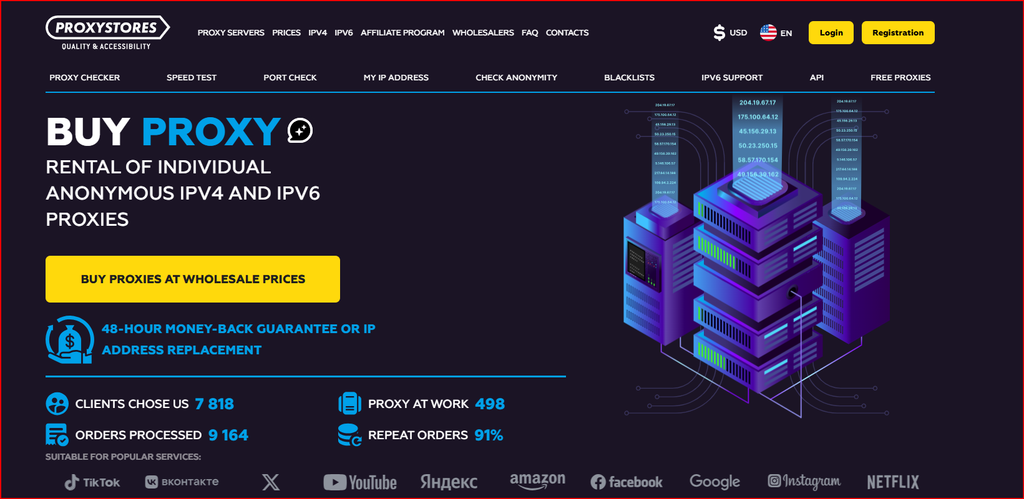
ProxyStores homepage screenshot used during this September 2026 marketplace-seller research workflow review.
How I Tested the Workflow
I started with a small set of public pages relevant to public marketplace seller research and regional assortment checks and avoided aggressive request rates. For every run I first confirmed the visible IP country, then opened the target in a clean browser profile, captured the visible market indicators, and repeated only the cases that showed a meaningful difference. I logged the final URL, currency or language if present, any market selector, response timing at a human browsing pace, and whether the page changed after cookies were accepted. This approach is slower than bulk automation, but it produces evidence that a marketing or QA team can actually review.
The second pass used the same endpoint to check reproducibility. That matters because a one-time difference can be caused by cache state, A/B testing, or a remembered user preference. A stable endpoint helps reduce one variable. I also compared IPv4 and IPv6 only where the target supported both. I treated a mismatch as an investigation item, not automatically as an error, because different CDNs or geolocation databases may be involved.
Why Dedicated IPv4 Matters
For public marketplace seller research and regional assortment checks, individual IPv4 is the most practical option when the same scenario must be repeated over several days. The benefit is not that a dedicated proxy is automatically residential or guaranteed to be trusted by every website. The benefit is consistency: the endpoint stays assigned to one customer during the rental period, which makes screenshots, bug reports, and before-and-after checks easier to compare. When a team is validating a regional issue, consistency usually matters more than constant rotation.
Shared IPv4 can still be useful for broad public-page spot checks and lower-cost market coverage. I would use shared addresses when I only need to confirm whether a public page is reachable and broadly localized, then move important defects to an individual IPv4 endpoint for reproducibility. This keeps costs low without sacrificing evidence quality on the cases that matter.
IPv6 as a Separate Test Path
I treated IPv6 as a separate compatibility path for public marketplace seller research and regional assortment checks. It is cheaper, but support is not universal and some sites route IPv6 traffic differently from IPv4. If the target application officially supports IPv6, testing a small sample can reveal differences in CDN edge selection, geolocation, or firewall rules. The key is to keep IPv6 results labeled separately so the team does not confuse an IP-family difference with a random application defect.
For practical QA, I would not choose IPv6 solely because it is cheaper. I would choose it when the production audience actually uses IPv6 or when the engineering team wants dual-stack coverage. For general public-web testing, IPv4 remains the more broadly compatible baseline.
SOCKS5, HTTP and Browser Profiles
ProxyStores publishes conventional HTTP/SOCKS5 support, which makes the service compatible with ordinary browsers and many authorized testing tools. For manual research I prefer a dedicated browser profile per market because it keeps cookies, local storage, and screenshots organized. For scripted checks, I would keep credentials outside the code, validate one endpoint first, and log transport errors separately from website findings.
That separation is important. A timeout, TLS failure, proxy-authentication error, blocked response, and incorrect regional page are not the same class of issue. If they are mixed together in one report, developers cannot tell whether the application is wrong or the test environment failed. Clean logging is one of the easiest ways to make proxy-based QA more credible.
What I Observed in the Service Structure
ProxyStores publishes shared and individual IPv4, IPv6, HTTP/SOCKS5 output, manual IP and subnet selection, city selection, 48-hour refund/replacement terms, immediate activation, and up-to-three-IP binding per order. Those features are useful for structured marketplace research because a team can label the network viewpoint and preserve it for repeat checks.
The structure is a good fit for teams that need controlled regional viewpoints rather than anonymous mass rotation. City and subnet selection, conventional protocols, short rental periods, and immediate activation are useful operationally because a tester can build a small market matrix without committing to a large pool. I would still verify the exact country inventory before a project starts, because availability can change and a specific city may matter more than a country-level endpoint.
Pricing and Budgeting
The pricing model is easy to budget for short QA cycles. The table below uses the current public pricing pattern for the main proxy classes and should be treated as a September 2026 snapshot rather than a permanent quote. Before ordering, I would verify ProxyStores pricing because country, quantity, and service availability can change. For a pilot, I would start with a handful of priority markets rather than buying a large pool immediately.
My preferred cost strategy is simple: use one individual IPv4 per critical market, shared IPv4 for wider spot checks, and IPv6 only where dual-stack coverage is relevant. That keeps the project focused on reproducible evidence instead of maximizing the number of IPs.
| Proxy type | 5 days | 30 days | 90 days | 360 days |
|---|---|---|---|---|
| IPv4 Shared | US$0.67 | US$0.99 | US$2.97 | US$11.88 |
| Individual IPv4 | US$0.96 | US$1.77 | US$5.31 | US$21.24 |
| IPv6/32 | US$0.10 | US$0.51 | US$1.53 | US$6.12 |
What I Liked
I liked the way the service model supports repeatable public-web QA. Short rental windows are useful for campaign or release testing, while longer terms make sense for recurring monitoring. The availability of both shared and individual IPv4 lets a team separate low-cost reconnaissance from higher-confidence reproduction. For public marketplace seller research and regional assortment checks, that is more useful than a single undifferentiated proxy product.
I also like the operational clarity of conventional protocols. A tester can use a browser, a simple request tool, or an internal QA harness without adopting a proprietary network client. That reduces setup friction and makes it easier to hand the workflow to another analyst.
What I Would Monitor or Improve
I would avoid using the workflow to infer private seller metrics or defeat marketplace controls. The useful scope is public market intelligence: visible assortment, regional messages, delivery availability, and localization. Account-specific ranking and recommendation behavior should be documented separately.
I would also keep the browser language, time zone, cookies, and account state documented alongside the proxy location. Many websites combine several signals before deciding what to show. If the team changes multiple variables at once, it becomes impossible to say which one caused the difference. A good regional QA process is less about having many IPs and more about controlling the full test context.
FAQ
Q: Is a proxy enough to prove what every user in a country sees? No. It gives a controlled network viewpoint. Browser language, cookies, account state, and A/B tests can also affect the result.
Q: Should I use shared or individual IPv4? Shared is useful for low-cost spot checks. Individual IPv4 is better when a result must be reproduced repeatedly with the same endpoint.
Q: Is IPv6 a replacement for IPv4? Not for general testing. Use it as a separate path when the target supports IPv6 and dual-stack behavior matters.
Q: Can this workflow be automated? Yes for authorized and rate-limited checks, but I would keep logging, market labels, and error categories explicit so automation does not hide bad test assumptions.
Conclusion
After evaluating the workflow, I see ProxyStores as a practical option for public marketplace seller research and regional assortment checks when the project values fixed regional viewpoints, conventional proxy protocols, and transparent short-term pricing. I would begin with a small market matrix, document every test variable, and expand only when a location actually produces a meaningful difference. For current availability and plan details, I would confirm the ProxyStores English website before purchasing.
